Judas: Why Ken Levine’s New Shooter Matters for Story-Driven FPS Fans

The announcement of Judas immediately drew attention from players who value narrative depth in first-person shooters. Developed under the direction of Ken Levine, the creative mind behind BioShock, the project aims to revisit the idea that gameplay and storytelling can evolve together rather than exist separately. As of 2026, Judas remains one of the most discussed upcoming releases in the genre, largely because it promises a more reactive story system and a player-driven approach to narrative outcomes.
A Return to Narrative-Driven FPS Design
Ken Levine’s previous work established a benchmark for storytelling in shooters, particularly with BioShock, where environmental storytelling and moral choices played a central role. Judas continues this tradition but expands it with a system designed to respond dynamically to player decisions. Instead of static dialogue trees, the game introduces narrative variables that shift relationships and events in real time.
The setting of Judas takes place on a generation ship, where factions, ideology, and personal conflicts shape the story. This confined yet complex environment allows for layered storytelling, where even minor interactions can have long-term consequences. The design echoes classic immersive sims but with a more focused narrative direction.
For fans of story-heavy FPS titles, this approach signals a move away from purely linear campaigns. Judas appears to prioritise player agency without sacrificing coherence, offering a structured narrative that still reacts to individual choices.
How Player Choices Shape the Story
One of the core mechanics highlighted by the developers is the so-called “Narrative LEGO” system, where story elements are assembled dynamically based on player actions. Rather than following a single path, players influence alliances, character trust, and plot developments throughout the game.
This system creates variability between playthroughs. Two players may encounter entirely different story arcs depending on whom they support or betray. Unlike traditional branching narratives, Judas attempts to avoid predictable outcomes by combining multiple narrative components in real time.
The result is a more personalised experience, where decisions feel less like scripted checkpoints and more like evolving consequences. This design aligns with the expectations of players who prefer meaningful interaction over passive storytelling.
Gameplay Systems Inspired by BioShock and Beyond
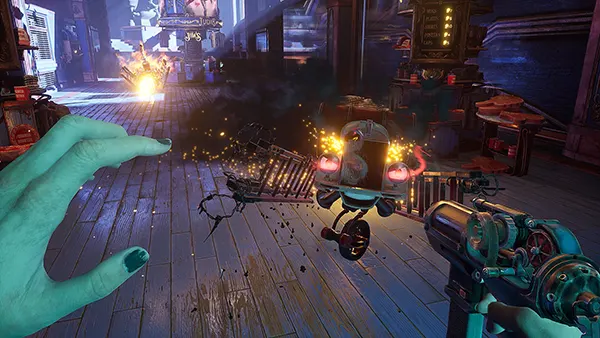
While Judas builds on the narrative foundations of BioShock, its gameplay systems also reflect modern expectations for first-person shooters. Players can expect a combination of weapon-based combat and abilities that alter how encounters unfold. These abilities are designed to interact with the environment, encouraging experimentation rather than repetition.
The game also integrates immersive sim elements, allowing multiple approaches to objectives. Whether through direct confrontation, stealth, or manipulation of systems, players have flexibility in how they progress. This design philosophy supports the narrative focus by reinforcing the idea that player choice extends beyond dialogue.
From what has been revealed so far, Judas avoids overcomplication in favour of depth. Each mechanic appears to serve both gameplay and narrative, ensuring that systems feel interconnected rather than isolated.
Combat, Exploration, and Player Freedom
Combat in Judas is expected to balance intensity with tactical decision-making. Players will need to consider resource management, enemy behaviour, and environmental factors. This approach moves away from simple run-and-gun mechanics and towards a more deliberate style of engagement.
Exploration plays a significant role as well. The generation ship setting offers diverse areas, each with its own story fragments, hidden details, and optional encounters. This encourages players to move beyond the main objectives and engage with the world at their own pace.
Freedom is not just a feature but a core design principle. By allowing different strategies and outcomes, Judas supports varied playstyles, making it appealing to both traditional FPS players and fans of immersive storytelling.
Relevance of Judas in the 2026 Gaming Landscape
By 2026, the FPS genre has become highly competitive, with many titles focusing on multiplayer modes or fast-paced action. Judas stands out by concentrating on narrative complexity and player-driven storytelling, areas that have seen fewer major releases in recent years.
The game’s development approach reflects a broader trend in the industry: a renewed interest in single-player experiences that offer depth rather than scale alone. This shift is particularly relevant for players seeking meaningful engagement rather than repetitive gameplay loops.
Judas also benefits from the reputation of its creative leadership. Ken Levine’s involvement adds credibility, especially among players familiar with his previous work. However, expectations are high, and the final release will need to demonstrate that its systems deliver on their promise.
Expectations and Potential Impact
Players expect Judas to redefine how stories are told in first-person shooters. If the dynamic narrative system performs as intended, it could influence future projects across the genre. Developers may adopt similar approaches, focusing on adaptable storytelling rather than fixed scripts.
At the same time, there is cautious optimism. Complex systems often face challenges in execution, particularly when balancing freedom with narrative clarity. The success of Judas will depend on how well these elements are integrated.
Despite these uncertainties, Judas remains a key title to watch. Its ambition to merge storytelling and gameplay in a meaningful way positions it as a potential milestone for narrative-focused FPS games.