Saints Row: The Third Remastered on Smartphones: Open World, Controls and Differences from PC
Saints Row: The Third Remastered has officially arrived on Android and iOS, bringing one of the most outrageous open-world crime games to smartphones and tablets. Released on 29 October 2026 by Feral Interactive, the mobile edition retains the complete Steelport adventure, including its main storyline, extensive character customisation, vehicles, side activities and downloadable content. Unlike simplified mobile adaptations of popular PC games, this release preserves the original experience while introducing touchscreen controls and optimisations for portable devices. Players can explore a large fictional city, complete missions, fight rival gangs and build their criminal empire without needing a computer or console. However, the smaller screen, different control methods and varying hardware capabilities create some important differences. Understanding how the mobile edition handles exploration, combat, driving and performance helps explain what players can realistically expect from Saints Row: The Third Remastered on a phone.
Exploring the Open World of Steelport on Android and iOS
Steelport is the central location of Saints Row: The Third Remastered, a fictional American city dominated by organised crime, wealthy corporations and heavily armed rival gangs. The story follows the Third Street Saints, who have transformed from an ordinary street gang into internationally recognised celebrities. Their success attracts the attention of the Syndicate, a powerful criminal organisation that controls much of Steelport. When the Saints refuse to submit to its demands, they become involved in a violent struggle for control of the city. The mobile edition preserves this storyline and its deliberately exaggerated approach to action. Players begin with limited influence in Steelport and gradually expand their presence through missions, criminal activities and confrontations with rival factions. The city is not simply a backdrop for scripted events: its roads, neighbourhoods, buildings and activity locations form an interconnected environment that encourages exploration between major objectives.
One of the defining features of Saints Row: The Third Remastered is the freedom to move around Steelport without following a fixed sequence of missions. Players can drive through the city, acquire vehicles, visit shops, purchase properties or start optional activities whenever these become available. Different districts contain businesses, gang operations, collectibles and opportunities to earn money and respect. The game also features several forms of transport, including ordinary cars, motorcycles, boats, helicopters and military aircraft. More unusual vehicles, such as tanks and futuristic flying machines, reinforce its preference for exaggerated action rather than realism. On smartphones, this variety is particularly important because it allows players to choose activities suitable for shorter sessions. A quick drive across the city or a brief side activity can provide entertainment without requiring a long period of uninterrupted play.
Steelport is divided between three major criminal factions: the Morningstar, the Deckers and the Luchadores. Each organisation has its own visual identity, preferred weapons and involvement in the city’s criminal economy. The Morningstar are associated with organised crime and arms dealing, the Deckers specialise in cybercrime, while the Luchadores rely on intimidation and physical force. Progressing through the campaign gradually weakens their influence and changes the Saints’ position within Steelport. Players can also purchase properties and businesses, creating additional sources of income that help fund weapons, upgrades and other purchases. This progression gives exploration a practical purpose. Travelling into unfamiliar districts can reveal new opportunities, while completing activities outside the main story provides resources for tackling more demanding missions later. The mobile release retains these interconnected systems rather than replacing them with a smaller collection of isolated levels.
Missions, Side Activities and Freedom of Exploration
The main campaign contains 47 missions that combine gunfights, vehicle pursuits, dramatic escapes and unusual objectives. Some missions involve attacking rival gang operations, while others introduce military equipment, aerial combat or situations that deliberately parody action films. The storyline regularly changes the pace by moving between conventional third-person shooting and spectacular set pieces. Players can also customise the Boss, the character they control throughout the adventure. The character editor offers extensive options for appearance, clothing and personal style, while shops around Steelport provide additional ways to change outfits. This freedom is retained on mobile, allowing players to create a distinctive character rather than choosing from a limited selection of predefined heroes. Importantly, the mobile release does not replace the original campaign with shorter missions designed exclusively for smartphone users.
Outside the story, Steelport offers activities that reward different approaches to gameplay. Insurance Fraud, for example, challenges players to cause spectacular accidents and accumulate damage by throwing their character into traffic. Mayhem focuses on destroying objects and causing widespread damage within a time limit, while other activities involve vehicle theft, dangerous driving, combat or transporting people through hostile territory. These challenges offer an alternative to the main campaign and allow players to earn rewards while becoming familiar with the city. They are also useful for mobile gaming because many can be approached as individual objectives. Players who have limited time can concentrate on a nearby activity rather than beginning a lengthy storyline mission. However, successful completion still depends on understanding the controls, particularly when quick steering, accurate movement or rapid weapon use is required.
Exploration becomes more rewarding as the Saints acquire additional abilities, weapons and vehicles. Money can be spent on character upgrades and equipment, while respect contributes to progression through the game’s upgrade system. Activities, properties and gang operations provide reasons to revisit districts that players may have previously passed through during story missions. Steelport also includes hidden collectibles and opportunities for spontaneous encounters with rival gangs or the police. These elements help the city remain relevant beyond the campaign’s immediate objectives. On a smartphone, the open-world structure works best when players use the map to plan their movements and combine nearby tasks. Completing several objectives within one district can reduce unnecessary travel and make shorter sessions more productive. The same approach is useful on PC, but it becomes especially convenient when playing on a handheld device during limited periods of free time.
Touchscreen Controls, Combat and Driving on Smartphones
The most significant practical change in Saints Row: The Third Remastered on mobile concerns its control system. The original PC release was designed around keyboard and mouse input, while the smartphone version introduces fully customisable touchscreen controls. Virtual controls allow players to move their character, adjust the camera, aim, fire weapons and interact with the environment directly through the display. This makes it possible to play without additional accessories, although the experience differs from using physical buttons. During simple exploration, touchscreen movement can feel relatively straightforward because players have time to adjust their direction and camera position. Combat is more demanding, especially when several enemies attack from different directions. The player must manage movement, aiming and weapon actions while keeping enough of the screen visible to understand the situation. Customisable controls help address this challenge by allowing the interface to be adapted to individual preferences.
Character movement and combat remain based on the third-person action system familiar from the PC edition. Players can use firearms, melee weapons and explosives, while certain missions provide access to more powerful or unusual equipment. The arsenal includes conventional pistols, shotguns and automatic weapons alongside weapons designed around the series’ exaggerated humour. Fighting often involves moving between enemies, changing weapons and reacting to vehicles or environmental hazards. On a touchscreen, these actions require greater attention to finger placement because virtual buttons occupy part of the display. A practical approach is to adjust the controls before starting difficult missions and become familiar with camera movement during ordinary street encounters. Maintaining a clear view of enemies and nearby cover is more important than pressing buttons quickly. Players accustomed to physical controls may need time to develop comfortable touchscreen habits, particularly during prolonged firefights.
Driving is another area where the mobile edition introduces a different feel without changing the underlying activities. Steelport contains vehicles with varied handling characteristics, from ordinary passenger cars to sports cars, motorcycles and heavy military equipment. Vehicle missions can involve high-speed pursuits, escaping police attention, transporting passengers or attacking enemy targets. Touchscreen controls must accommodate acceleration, braking, steering and camera movement, sometimes while the player is also using weapons. This combination can be more difficult on a small display than with a keyboard or controller. Vehicles that respond quickly to steering may require more careful inputs, particularly during fast turns or narrow streets. Players can reduce unnecessary mistakes by learning how different vehicles behave before attempting demanding challenges. A comfortable control arrangement is especially useful for missions involving timed journeys, prolonged chases or simultaneous driving and shooting.
Controller Support and Practical Control Settings
Players who prefer physical controls can connect a compatible gamepad to Saints Row: The Third Remastered on supported mobile devices. Feral Interactive has confirmed controller support across the mobile release, alongside keyboard and mouse compatibility on iPadOS and Android. This flexibility is particularly valuable because the game was originally designed for systems with dedicated input devices. A controller provides physical analogue sticks for movement and camera adjustment, together with buttons and triggers for combat and vehicle controls. These features can make certain actions easier to manage, especially when aiming and moving simultaneously. A smartphone connected to a controller can therefore provide a control arrangement closer to the console experience, while a compatible tablet with keyboard and mouse support offers an alternative for players familiar with PC gaming. The available control options should be checked against the specific device and accessories being used.
Touchscreen customisation is worth considering even for players who normally prefer mobile controls. The ideal layout depends on hand size, screen dimensions and the activities being performed. Buttons that are comfortable during exploration may become inconvenient when several actions must be performed quickly. For example, placing frequently used combat controls within easy reach can reduce the need to stretch across the display, while keeping the centre of the screen relatively clear improves visibility. Players should test their preferred arrangement in low-pressure situations before beginning missions with strict time limits or intense combat. Camera control also deserves attention, as the ability to follow moving enemies or monitor traffic can determine whether an encounter is manageable. There is no single arrangement that suits every player. The main advantage of the mobile edition is that its touchscreen layout can be adjusted instead of forcing everyone to use one fixed control scheme.
Screen size has a noticeable influence on how the game is controlled. On a smartphone, the player’s thumbs may cover parts of the surrounding environment, making it harder to monitor enemies or recognise smaller visual details. Tablets offer more physical display space, potentially improving visibility and reducing crowding around virtual buttons. However, larger devices can also be less comfortable to hold during extended sessions, making a controller or stand a practical option. Players using a compact phone may prefer simpler control arrangements and shorter sessions, while those using a tablet can benefit from a display that provides more room for the game’s busy action scenes. Regardless of device size, the mobile edition retains the original movement, shooting and driving mechanics rather than introducing a fundamentally different combat system. The main adjustment is how players interact with those mechanics through their chosen controls.
Differences Between the Mobile and PC Versions
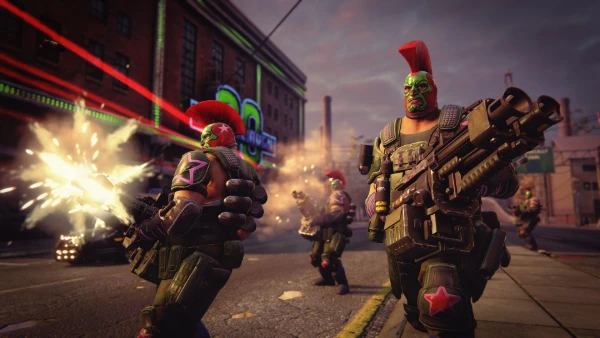
Saints Row: The Third Remastered was originally released for PC, PlayStation 4 and Xbox One in May 2020, updating the 2011 game with improved lighting, revised environments, enhanced character models and additional visual effects. The Android and iOS editions, released on 29 October 2026, were developed for mobile by Feral Interactive. Rather than creating a separate story or substantially reducing the game’s content, the mobile adaptation brings the remastered experience to compatible phones and tablets. The campaign, Steelport environment, character customisation, vehicles and additional missions remain part of the package. The principal differences concern input methods, hardware requirements and the way the game is presented on a portable screen. PC players can use a conventional desktop setup with a larger monitor and adjustable computer hardware, while smartphone users depend on the performance capabilities and compatibility of their individual devices.
The remastered edition introduced substantial visual improvements over the original Saints Row: The Third, including updated lighting, improved textures and redesigned environmental details. Feral Interactive states that these enhanced visuals have been carried over to Android and iOS. Nevertheless, the experience of viewing a detailed city on a small phone screen is different from playing on a large PC monitor. Distant objects, smaller interface elements and background details may be less noticeable, particularly during fast-moving missions. Actual visual quality and smoothness can also depend on the device’s processing power, graphics capabilities and operating conditions. Modern smartphones vary considerably in performance, so players should not assume that every compatible device will behave identically. Published support information and device-specific testing are more reliable than general claims that the mobile edition performs exactly like a high-end gaming PC.
Content availability is one of the mobile edition’s strongest points of comparison with PC. The release includes the original downloadable content, including the Genkibowl VII, Gangstas in Space and The Trouble With Clones mission expansions. These additions introduce new story situations and activities beyond the central campaign. The package also contains more than 30 extra weapons, vehicles and costumes, giving players additional options for combat, travelling and character customisation. Feral Interactive has also retained online cooperative gameplay, allowing two players to experience the campaign together rather than limiting the mobile release to single-player missions. This is an important distinction from mobile adaptations that remove multiplayer features or sell substantial parts of their content separately. However, successful cooperative play depends on suitable network conditions, and the availability of online co-op does not automatically establish compatibility between mobile players and users of the PC edition.
Performance, Compatibility and Choosing the Right Version
Hardware compatibility deserves particular attention before purchasing Saints Row: The Third Remastered for a smartphone. On iOS, the game requires iOS 18 or later and supports selected iPhone and iPad models. The official App Store listing includes the iPhone 11 family and newer supported devices, the iPhone XS and XS Max, and the third-generation iPhone SE. Supported tablets include the tenth-generation iPad or newer, the sixth-generation iPad mini or newer, the fourth-generation iPad Air or newer, and the third-generation iPad Pro or newer. The iOS listing also states that approximately 22 GB of free storage is required, with substantially more free space recommended to avoid initial installation problems. These requirements illustrate that this is a sizeable desktop-style game rather than a lightweight mobile application. Android users should check the official Google Play listing for compatibility with their specific model before buying, since a modern operating system alone does not guarantee that a device is supported.
Long gaming sessions introduce practical considerations that are less noticeable on a desktop computer. Running a large open-world game places sustained demands on a smartphone’s processor and graphics hardware, which can increase power consumption and generate heat. Depending on the device, environmental temperature and operating conditions, extended gameplay may affect battery life or cause performance to vary. Players can help maintain a more comfortable experience by avoiding direct sunlight, closing unnecessary background applications and keeping enough storage available for normal operation. Stable internet access is particularly important when using online cooperative features, although the main single-player experience does not depend on joining another player. Headphones can also be useful in public settings, given the game’s frequent dialogue, combat effects and extensive soundtrack. These considerations do not change the game’s content, but they influence how convenient it is to play away from a conventional gaming setup.
The decision between mobile and PC ultimately depends on how and where the game will be played. PC remains a suitable choice for players who prefer a large display, traditional keyboard and mouse controls, and the flexibility of a desktop gaming setup. The mobile edition is particularly attractive to those who want the complete Steelport experience on a portable device, with the option of switching between touchscreen and physical controls. It is sold as a premium game, with Feral Interactive announcing a UK launch price of £12.99, although local store pricing may differ. Players receive the main campaign, cooperative functionality and the included expansions without needing to purchase the original downloadable content separately. For those with compatible hardware, Saints Row: The Third Remastered offers a substantial open-world adventure on Android and iOS. Its greatest achievement is not changing the identity of Saints Row, but preserving the large-scale missions, chaotic combat and freedom of Steelport in a form designed for mobile play.